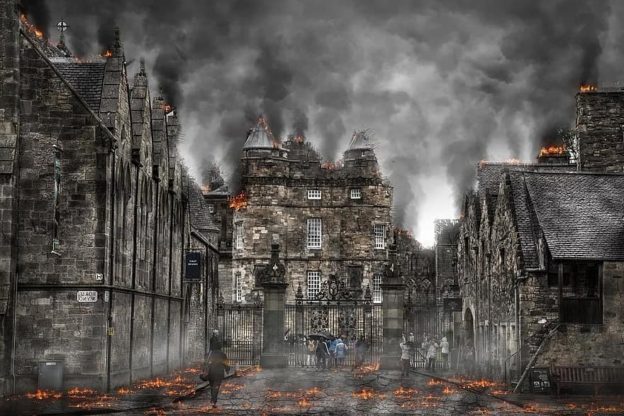
In the Roman Catholic Church, one of the most well attended liturgies occurs on Ash Wednesday when observant and semi-observant Catholics get “ashes” in the shape of a cross on their foreheads with the priest saying to each “Remember that thou are dust and to dust thou shall return.” It is a genius sentence as believers will understand that the “dust” at the end is the prelude to eternal life while “non-believers” will acknowledge that there is only dust at the end.
Ash Wednesday begins the 40 days of Lent where believers are encouraged to practice what they preach, to fast and perform other ascetic practices to bring them closer to God, all leading to Easter Sunday and the belief in the resurrection.
The Russian Orthodox Church, which is closely aligned with the Roman Catholic Church and is the predominant church in Ukraine, does not distribute ashes but requires even stricter fasting rules during its Lent which occurs at a slightly different time than that observed in the Western church because it follows the Julian, not the Gregorian, calendar. Nevertheless, the concept of Lent is identical.
On February 24, 2022, four days before Ash Wednesday, Russia invaded Ukraine and the “ashes” it brought arose from the rubble of buildings being bombed, including a maternity hospital. This invasion proved that the past is often the prelude. In 2014, Russia invaded the Crimea which was then, but is no longer, a part of Ukraine. The American response under President Obama and that of the rest of the West to the invasion of the Crimea could only have emboldened Vladimir Putin as it was the equivalent of “Hey, you shouldn’t have done that.”
This time it was different. President Biden has been called “Sleepy Joe.” Unlike Obama, however, he was not asleep at the switch. Indeed, he orchestrated a free world response to this invasion which was both dramatic and unprecedented. The Russian economy is in freefall because of the Western sanctions and its oligarchs are trying to sail their super yachts to safe harbors but are finding none in Europe. Putin’s miscalculation has effectively organized the “free” world in ways he never expected. Putin wanted Ukraine to back off from NATO but now has both Finland and Sweden talking about joining.
But there are always dissenters. A small minority of the American left, fixated on American misdeeds, has actually justified the Putin invasion by stating that it is the end result of America encouraging Ukraine to be a part of the West which is an affront to Putin.
If one scores those on the left for their comments, they do not hold a candle to the drivel on the right. Former President Trump said: “I went in yesterday and there was a television screen, and I said, ‘this is genius.’ Putin declared a big portion of the Ukraine … as independent. Oh, that’s wonderful.” Fox News commentator Tucker Carlson is in the truly embarrassing position of having his comments replayed on Putin-controlled Russian TV. Republicans in Congress have not been silent. Representative Madison Cawthorn referred to President Zelensky as a “thug” while many people are comparing him to Winston Churchill rallying the British people during the Blitz. Representative Marjorie Taylor Greene, who many say is the queen of “crazies,” said that the war was created by President Biden because he is “weak.”
John Mearsheimer is an American political scientist and international relations scholar who is a Distinguished Professor at the University of Chicago. He belongs to the realist school of thought and has been described as the most influential realist of his generation. He predicted that the encouragement of Ukraine to join the EU and apply to NATO would result in the current mess as Russia would be forced to protect its flanks. In Mearsheimer’s view, “great” powers will always lord it over the lesser ones which they deem to be in their orbit. Hence, China and Taiwan, the United States and South America, Russia and Ukraine. In a phrase, “might makes right.” That is the way it is, always has been and always will be.
The essential problem with this view is that it equates power with proper behavior as if there were no difference. While Russia may not like a pro-western Ukraine, who says that Russia has any right to say anything about it? Russia may not like a free Hungary or a free Czechoslovakia or a free Estonia, Lithuania and Latvia but those countries surely don’t cotton to Russia either. The Hungarians saw Russian tanks in Budapest in 1956. The Czechs saw Russian tanks in Prague in 1968. The Baltic republics are only 30 years away from when the Soviet Union controlled their lives. These countries all joined NATO as soon as they could and the reason was this: they had suffered plenty and they wanted to keep the Russians from returning.
The whole notion of “great” powers assumes that there are one or two or three “great” powers and the surrounding states are like pawns on a chessboard. However, as students of chess know, a pawn can sometimes checkmate a king. That is the story of Lech Walesa and the Solidarity Union movement in Poland. Started in 1980 at the Vladimir Lenin shipyard at Gdańsk, it led to semi-free elections in 1989 and Walesa was elected President of a now free Poland in 1990. This time around, the Russians did not send tanks but depended on their government allies in Warsaw. Between 1980 and 1989, Solidarity was outlawed under martial law, Walesa was imprisoned but nothing made a difference. Solidarity survived with the explicit help of a Polish Pope and the clandestine help of western intelligence agencies and was the first to sound the death knell of the Soviet Union.
So how will Ukraine end? Presumably, the vastly superior Russian army will “win” and President Zelensky may be executed. But if he is executed, the fight will have only just begun as he has become the Winston Churchill/Lech Walesa of his country. The Russians can say all they want about how Ukraine is part of Russia but Ukraine has always resisted. Stalin detested the Ukrainian farmers who did not reach their quota of crops when his 5 Year Plan, depending on collective farms, proved a bust. Solution: order grain out of Ukraine and let at least 4,000,000 Ukrainians starve to death. The Ukrainians call this genocide Holodomor (Death By Hunger) and it is commemorated on Holodomor Memorial Day, the 4th Saturday of November, with a minute of silence at 4 PM with flags at half-mast. Ukrainians have never forgotten.
Hopefully, we have learned a few things out of this debacle. First, there is a great danger if we only believe that “might makes right.” Second, while any country has to be prudent in responding to such actions as are now occurring in Ukraine, there are any number of actions in our financially interconnected world that can make an important difference. And, in this case, they already have. Third, freedom is an aphrodisiac for the human soul. Once loosed, it cannot be contained.
Ukraine knows freedom and how to fight for it. In 2014, months of popular protests swept pro-Russian President Viktor Yanukovych from office when he reneged on his promise to sign long anticipated association and trade agreements with the European Union. Instead he decided to expand ties with Russia. In the end, Yanukovych scurried home to Moscow in order to avoid a slew of criminal charges. This is known as the Maidan Revolution (Revolution of Dignity) and is featured in a documentary entitled Winter on Fire: Ukraine’s Fight for Freedom now streaming on Netflix.
There is a reason that the “free world” will always triumph over the authoritarian world. Neither Russia nor China has an immigration problem since people are not trying to get in but, rather, trying to get out.
Russia has given the world majestic music and wonderful literature and poetry. Putin’s Russia has given the world nothing but war (Syria, now Ukraine) and has allowed him to enrich himself and his oligarch buddies. The “great” power, Russia, is, in the late John McCain’s words, “A gas station run by a mafia that is masquerading as a country.”
So, in this season of Lent, we can only pray that the present mess ends well and that Ukraine survives without mounds of ashes.
I always learn something from you. I am passing this blog on to friends. Thanks for expressing your thoughts so clearly. I look forward to watching the documentary on Netflix.
Jay,
I hope you get out.
Remember when you, Ed and I arrived in Moscow how the little Stalinist who was our guide/keeper right away pointed out the tank barrier that marked the stopping point of the German invasion? May the barriers hold in Ukraine – with US and world support, whatever is required.
What follows may be your first response in Spanish, praise from one of the members of a Chicago area Spanish conversation meetup group: “Tom, gracias por el enlace al blog de Jay Schwartz. Está maravillosamente argumentado y bellamente escrito. También estoy de acuerdo con ello. Digo a Jay que admiro mucho su publicación.”
On the other hand, the blog essay did not convince another group member, also a smart man: “Pero, obviamente no estoy de acuerdo con Jay. Tal vez en el futuro tengamos la oportunidad a explicar nuestros puntos de vista más.” – Love, Tom
Question, Jay: After Putin amassed his troops on Ukraine’s border and the U.S. predicted an invasion, what would have happened if Biden with NATO had declared to Putin that: “Once you drop a bomb or invade, Ukraine automatically becomes a member of NATO and Article 5 will commence.”
Do you think Putin would want to go up against NATO? Do you think he’d launch nuclear weapons?
If we’re really willing to risk WW111 if a former Soviet member of NATO is attacked, why wouldn’t we be willing to do the same for Ukraine? Because of a piece of paper that wasn’t signed?
Jay – I am late to this blog, since I just became aware. I read your blog, and it is a philosophical, emotional, well-written treatise that sides with the Neocons and their philsophy of hegemony. I think if we analyze the timeline and look at the sources we can see this is another war of which we are guilty of instigating. – please read my sources and listen to Victoria Nuland’d “F.ck the EU” about our complicity before we overthrew a democratically govt. without an election. From my research I believe this war, like all of those starting with Vietnam (the NYT Editorial Board did not call for the US to withdraw from Vietnam until 1971, after 50,000 of our US brothers and sisters were killed) have been orchestrated by the US and the CIA. Please review my documentation and sources in the following, and then we can dissect over a beer. Best, Fred
Please take some time to listen listen and read the following: all of these are all Western sources (CIA, NYT, MIT, U of Chicago, etc) I’ve researched I believe extensively and honestly since the start of the war. Please send me your sources as to your justification for our proxy war.
The US lied to its citizens about Viet Nam, Afghanistan ( US rtesponsinble for 80,000 civilian deaths and now 2024 80% controlled by Taliban, Irag (there were no WMD), Libya (Gaddafi), Syria (now controlled by Al Queda), and now the Ukraine.
https://www.google.com/search?sca_esv=0faa7ca32d0b11c4&tbm=vid&q=mearsheimer+and+origins+of+ukrainian+war&sa=X&ved=2ahUKEwjvlJy7q7SGAxV7vokEHdjfAqIQ8ccDegQIERAH&biw=731&bih=407&dpr=3.5#fpstate=ive&vld=cid:ff8e1f81,vid:emD1cN2xEz4,st:
Please listen to Professor Merscheimer, U. of Chicago:
https://youtu.be/JrMiSQAGOS4?si=ulaNE0NTWPO_-qoM
and Professor Sacks of Columbia U.
https://youtu.be/uvFtyDy_Bt0?si=YwVG2mn3bjebeIZl
NATO’s involvement, with US and others complicity, left Afghanistan (Taliban now control 80%,), Iraq, Libya in shambles, as will be the Ukraine. NATO is now also involved in Africa, Asia, and South America.
Study the major Ukrainian timelines:
1) 1991 Ukraine established relations with NATO
2) 1999 Putin became President of Russia. Throughout the early 2000’s Putin repeatedly stated that NATO involvement in the Ukraine (Crimea was part of the Ukraine at that time) was completely unacceptable. He knew once NATO was entrenched the US-Nato axis could block the Black Sea-Mediterranean access for Russia; 30% of Russia’s international sea trade went through that route.
3) 2008 Bucharest Summit NATO decides Ukraine and Georgia would eventually become NATO members despite opposition from Putin (how could the US justify nuclear weapons in light of the 1962 Cuban missile crisis)
4) A 2010 democratically elected Ukrainian govt.
5) Feb. 2014 the Ukrainian govt. forms closer ties to Russia
6) Maiden Movement 2-23-14 with overthrow of a 2010 elected pro-Russian government without an election orchestrated by the US-CIA ºsee reference below)
Also, This is the tape of Asst. Sec of State Victoria Nuland planning the Ukrainian cabinet for the US govt. with our Amb. Jeffery Pyatt (and full knowledge of President Biden) – they do not want to involve the EU and she made the famous statement: “Fuck the EU.” This was 27 days before the US-CIA democratically elected overthrew the democratically elected Pres. Yanukovych on Feb. 22, 2014.
https://youtu.be/kGq_Xvzn_3I?si=zS-jmZfiTt0NBoPG
7) Russian troops 2-27-14 (4 days after the Maiden Movement) enter Crimea thus negating future NATO occupation of the Black Sea to the Mediterranean route
8) Russian troops 2/22 invade the Ukraine because of the Ukrainian-NATO-US incumbent aggression on the Eastern Front-Crimea
In a multipolar world the US-NATO’s refusal to negotiate a settlement of a Russian eastern 1/3 and a western 2/3 Ukrainian states is a possible military suicide by all involved countries.
ºReference: The US-NATO alliance overthrew a 2010 democratically elected Ukrainian govt. (Yanukovych) without a new election in 2014 because he wanted a closer alliance with Russia. The CiA was instrumental in this change of govt. -“Revolution of Dignity ” or “Maiden Revolution”.
This occurred from Feb 18 to 23. Ukraine still controlled Crimea. Putin was “cooked”, because the US-NATO could now block the Black Sea-
Mediterranean sea route, thus taking away 30% of Russia’s international trade. Therefore he invaded Crimea on Feb. 24., which at the time was
70% ethnic Russian and 15% Ukrainian.
Please note the timeline.
Also read this article from NYT, your fellow US-NATO apologists.
https://www.nytimes.com/2024/02/25/world/europe/cia-ukraine-intelligence-russia-war.html
The following research on the origins of the Ukrainian war:
Based on the search results, here is the timeline of NATO’s expansion into Eastern Europe: (after it’s founding 1949 with his core members) – now it is in Africa, South America, Asia, etc.
1952: Greece and Turkey join NATO, marking the alliance’s first expansion.
1955: West Germany becomes a member of NATO, leading the Soviet Union and seven Eastern European countries to form the Warsaw Pact in response.
1994: Finland and Sweden join NATO’s Partnership for Peace program, effectively ceasing to be neutral but remaining militarily non-aligned.
1999: The Czech Republic, Hungary, and Poland become full members of NATO, the first former Warsaw Pact nations to join.
2004: The largest NATO expansion to date, with seven more countries joining: Bulgaria, Romania, Slovakia, Slovenia, Estonia, Latvia, and Lithuania. The Baltic states are the only former Soviet republics to have joined NATO.
2008: NATO expresses support for Ukraine and Georgia’s aspirations to join the alliance, angering Russia.
2009: Croatia and Albania become NATO members.
2017: Montenegro joins NATO.
2020: North Macedonia becomes NATO’s 30th member.
2022: Finland and Sweden explore the possibility of joining NATO in response to Russia’s invasion of Ukraine. Finland did join in 2023 and Sweden is pending.
The search results show that NATO’s expansion into Eastern Europe accelerated after the end of the Cold War, with several waves of new members joining in the 1990s and 2000s, much to Russia’s dismay[1][2][3][4][5].
The MIT source takes some time to read, but this is a tremendous compendium of everything that’s going on as far as Ukraine is concerned. from a MIT professor. Here are some extracted paragraphs that are very very important to the Ukrainian war:
Drawing on a wider array of U.S. archival materials than prior studies and applying insights from international relations theory, this article refines and challenges scholarship on a NATO non-expansion pledge by tracing the evolution of U.S. policy toward the Soviet Union and European security throughout the 1990 diplomacy on reunification.17 In line with research by Sarotte and others sympathetic to Russian claims, I show that despite the absence of a formal deal, the United States did raise the issue of NATO expansion with the Soviet Union during the 1990 negotiations. In contrast to what scholars sympathetic to Russian claims propose, however, I argue that the topic of NATO expansion was more than just a fleeting aspect of the negotiations in February 1990. Additional archival evidence indicates that U.S. officials repeatedly offered the Soviets informal assurances—a standard diplomatic practice—against NATO expansion during talks on German reunification throughout the spring, summer, and fall of 1990. Central to this effort was a series of bargaining positions through which the George H.W. Bush administration indicated that Europe’s post–Cold War order would be acceptable to both Washington and Moscow: NATO would halt in place, and Europe’s security architecture would include the Soviet Union.18 Collectively, this evidence suggests that Russian leaders are essentially correct in claiming that U.S. efforts to expand NATO since the 1990s violate the “spirit” of the 1990 negotiations: NATO expansion nullified the assurances given to the Soviet Union in 1990.19
Distinct from what Soviet leaders were told in 1990, however, I also present new evidence suggesting that the United States used guarantees against NATO expansion to exploit Soviet weaknesses and reinforce U.S. strengths in post–Cold War Europe. To do so, the United States adopted positions designed to give it a free hand in Europe following German reunification—allowing it to decide whether and how to expand the U.S. presence on the continent—even while telling Soviet leaders that Soviet interests would be respected. Baldly stated, the United States floated a cooperative grand design for postwar Europe in discussions with the Soviets in 1990, while creating a system dominated by the United States. Although it remains unclear whether and why Soviet leaders believed the U.S. proposals, this two-pronged strategy helps explain how the United States exploited the reunification issue to reify its preeminence in post–Cold War Europe.20 By extension, the U.S.-Russian dispute over NATO expansion may be less a product of Soviet/Russian misrepresentation or misinterpretation of what happened in 1990, and more the result of the divergence between the cooperative approach that the United States presented to the Soviet Union and the United States’ quieter efforts to maximize its power in Europe.
This is the source MIT:
https://direct.mit.edu/isec/article/40/4/7/12126/Deal-or-No-Deal-The-End-of-the-Cold-War-and-the-U
And easier read:
https://www.vox.com/22900113/nato-ukraine-russia-crisis-clinton-expansion
In fact, Putin has frequently echoed Dugin’s Eurasianist views in public statements, beginning with his infamous Munich speech of 2007. Additionally, it is worth noting that both Putin and Dugin are members of the high-level think tank the Valdai Discussion Club, a Moscow-based think-tank and intellectual forum, so there can be no question that Putin is aware of Dugin’s ideas—though there are questions regarding his influence during the current war in Ukraine.
https://europeanconservative.com/articles/commentary/did-dugins-neo-eurasianism-inspire-russias-war-in-ukraine/
All sources below are pro-American:
In April 2008, Russian President Vladimir Putin spoke out against Ukraine’s membership in NATO.
US President George W. Bush and both nominees for President of the United States in the 2008 election, U.S. senator Barack Obama and U.S. senator John McCain, did offer backing to Ukraine’s membership of NATO.[52][53][54] Russian reactions were negative. In April 2008, Russian President Vladimir Putin spoke out against Ukraine’s membership in NATO.[55][56]
https://en.wikipedia.org/wiki/Ukraine%E2%80%93NATO_relations#:~:text=In%20April%202008%2C%20Russian%20President,against%20Ukraine's%20membership%20in%20NATO.
Please read – source NATO itself:
Dialogue and cooperation started when newly independent Ukraine joined the North Atlantic Cooperation Council (1991) and the Partnership for Peace programme (1994).
Relations were strengthened with the signing of the 1997 Charter on a Distinctive Partnership, which established the NATO-Ukraine Commission (NUC) to take cooperation forward.
Since 2009, the NUC has overseen Ukraine’s Euro-Atlantic integration process, including reforms under the Annual National Programme (ANP).
Cooperation has deepened over time and is mutually beneficial, with Ukraine actively contributing to NATO-led operations and missions.
Priority is given to support for comprehensive reform in the security and defence sector, which is vital for Ukraine’s democratic development and for strengthening its ability to defend itself.
Since the NATO Summit in Warsaw in July 2016, NATO’s practical support for Ukraine is set out in the Comprehensive Assistance Package (CAP) for Ukraine.
In June 2017, the Ukrainian Parliament adopted legislation reinstating membership in NATO as a strategic foreign and security policy objective. In 2019, a corresponding amendment to Ukraine’s Constitution entered into force.
In September 2020, President Volodymyr Zelenskyy approved Ukraine’s new National Security Strategy, which provides for the development of the distinctive partnership with NATO with the aim of membership in NATO.
https://www.nato.int/cps/en/natohq/topics_192648.htm
Since 2014, the United States has provided more than $37.8 billion in security assistance for training and equipment to help Ukraine preserve its territorial integrity, secure its borders, and improve interoperability with NATO.
While it’s unclear exactly how each and every country’s leadership feels in 2022 about Ukraine’s status, the process has been largely stalled since 2008. That year, as Ukraine sought to join MAP, President George W. Bush cast his support behind the idea during a summit in Bucharest.
“Welcoming [Ukraine and Georgia] into the Membership Action Plan would send a signal to their citizens that if they continue on the path to democracy and reform they will be welcomed into the institutions of Europe,” Bush said in a speech. “It would send a signal throughout the region that these two nations are, and will remain, sovereign and independent states.
“So my country’s position is clear: NATO should welcome Georgia and Ukraine into the Membership Action Plan.”
But Bush didn’t garner support from key allies, including France, Germany and others, The New York Times reported, amid fears the decision would inflame tensions with Russia. And indeed, Putin — still serving in his first stint as president — and other Russians at the time lashed out against the idea that either country might move closer to NATO.
“Georgia’s and Ukraine’s membership in the alliance is a huge strategic mistake which would have most serious consequences for pan-European security,” Deputy Foreign Minister Alexander Grushko said during the summit, according to Ukraine’s Interfax news agency.
Little changed over the subsequent years among European leaders, while the U.S., if anything, has eased back from its once-enthusiastic position. While Biden in the past has supported Ukraine’s entry into NATO, he has kept a cool tone in addressing the possibility over the past year. In June 2021, when asked for a “yes or no” on whether Ukraine would be allowed to join, he said “School’s out on that question. It remains to be seen,” adding they had more work to do to clean up corruption and improve in other areas to qualify for MAP.
https://www.nbcchicago.com/news/national-international/ukraine-wanted-to-join-natos-alliance-for-years-what-stopped-it/2813488/
The question: Should NATO, the mutual defense pact formed in the wake of World War II that has long served to represent Western interests and counter Russia’s influence in Europe, expand eastward?
NATO’s founding articles declare that any European country that is able to meet the alliance’s criteria for membership can join. This includes Ukraine. The U.S. and its allies in Europe have repeatedly said they are committed to that “open-door” policy.
How Russia’s invasion of Ukraine could impact you
WORLD
How you may be affected by Russia’s invasion of Ukraine
But in the words of Russian President Vladimir Putin, NATO’s eastward march represents decades of broken promises from the West to Moscow.
“You promised us in the 1990s that [NATO] would not move an inch to the East. You cheated us shamelessly,” Putin said at a news conference in December.
The U.S. says a ban on expansion was never on the table. But Russia insists it was — and now, Putin is demanding a permanent ban on Ukraine from joining the pact.
https://www.npr.org/2022/01/29/1076193616/ukraine-russia-nato-explainer
This is another summary of tyhe origins of the war by Jeffrey Sachs from Columbia; I think this is a good resume:
https://www.youtube.com/watch?v=jj7c4O8iJSg